Red Prawn Durian Care Guide: Growing the Prized Tropical Fruit Tree
The ‘Red Prawn’ Durian, a magnificent tropical fruit tree, holds a special place in the hearts of fruit enthusiasts across India and Southeast Asia. Its legendary fruit, with its distinctive aroma and rich, creamy flesh, is a delicacy eagerly anticipated by many. While its pungent smell might be an acquired taste for some, the exquisite flavour of the ‘Red Prawn’ variety makes it a highly sought-after gem for those who appreciate the king of fruits.
For home gardeners in suitable tropical climates, growing your own ‘Red Prawn’ Durian can be an incredibly rewarding experience. It’s a journey that connects you deeply with nature and allows you to cultivate one of the world’s most unique and delicious fruits. As you embark on this rewarding horticultural adventure, remember that Plantrea is the online plant platform by Wynorg, a trusted Indian brand known for delivering healthy live plants safely across India, ensuring your gardening dreams start on the right foot.
Botanical Overview
The ‘Red Prawn’ Durian is a specific cultivar of *Durio zibethinus*, the most common species of durian. While the general species is native to Borneo and Sumatra, the ‘Red Prawn’ cultivar itself is highly prized and largely associated with Malaysia, particularly Penang. This majestic plant belongs to the Malvaceae family, which also includes cotton and hibiscus, though its large stature and thorny fruit set it apart.
As a plant type, it is a large, evergreen tropical fruit tree. In its natural habitat, a ‘Red Prawn’ Durian tree can reach impressive heights of 20 to 40 meters, developing a dense, broad canopy. Its growth habit is upright and vigorous, forming a sturdy trunk and strong branches that support its future bounty. The glossy, dark green leaves are oblong and leathery, providing a lush, tropical aesthetic even before the fruit appears.
Why People Love This Plant
The allure of the ‘Red Prawn’ Durian goes far beyond its botanical classification. It’s a plant that commands attention and devotion, primarily for its incredible fruit.
Appearance
The tree itself is quite handsome, with its impressive height and broad, verdant canopy providing ample shade in a tropical garden. The leaves are a rich, dark green, shimmering in the sunlight. When the ‘Red Prawn’ Durian flowers, typically in clusters directly on the woody branches, it produces pale white to yellowish-white blooms. While not as showy as some ornamental flowers, they hold a subtle charm and herald the arrival of the much-anticipated fruit.
Flowers
The flowers of the ‘Red Prawn’ Durian are fascinating. They bloom in the late afternoon or evening, releasing a mild, sweet fragrance that attracts nocturnal pollinators, primarily bats and moths. These delicate, star-like flowers are crucial for fruit production, appearing in profusion during the flowering season, which can vary but often occurs biannually.
Foliage
The foliage of the ‘Red Prawn’ Durian is dense and evergreen, providing a lush backdrop in any tropical landscape. The glossy, dark green leaves contribute to the tree’s majestic appearance, creating a serene and inviting atmosphere in a large garden or orchard. The sheer volume of its leaves also contributes to creating a cooler microclimate beneath its canopy.
Fragrance
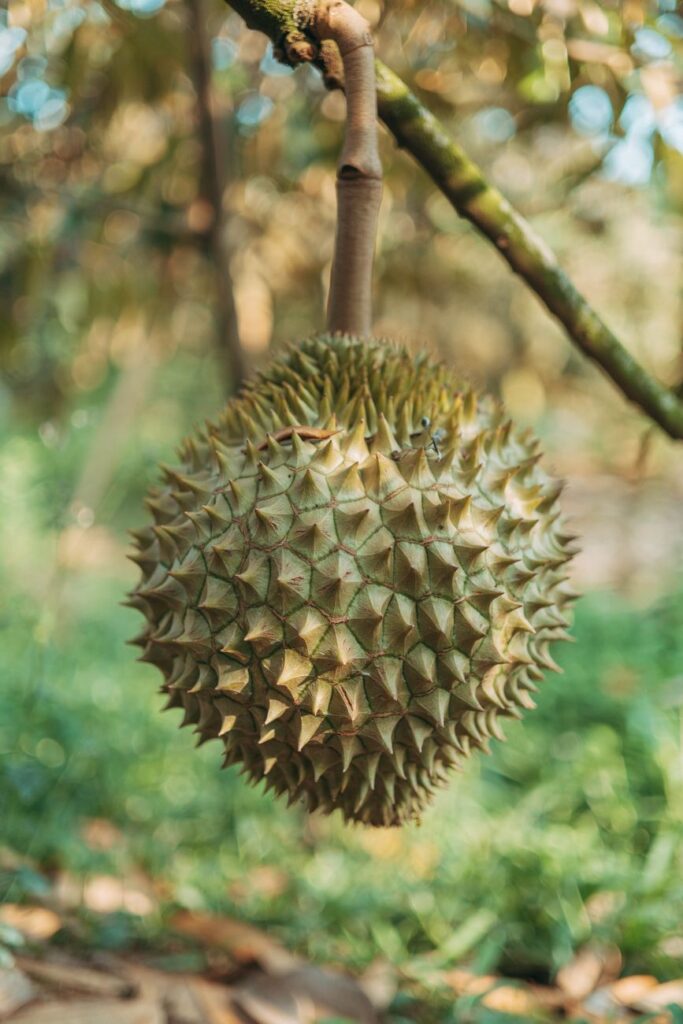
While the flowers possess a mild, pleasant scent, it’s the fruit’s fragrance that is legendary. The ‘Red Prawn’ Durian fruit is famously pungent, a characteristic that either repels or entices. For connoisseurs, this strong aroma is an integral part of the durian experience, promising the rich, complex flavours within. The ‘Red Prawn’ variety specifically is celebrated for its balance of sweetness and subtle bitterness, encased in a remarkably creamy, almost custardy, reddish-orange flesh.
Decorative Value
Beyond its fruit, the ‘Red Prawn’ Durian tree has significant decorative value in large tropical landscapes. Its imposing stature, dense canopy, and lush green foliage make it an excellent choice for creating shade and a focal point in expansive gardens or as part of a diverse agroforestry system. It offers a sense of permanence and grandeur that few other fruit trees can match.
Growing Requirements
Cultivating a ‘Red Prawn’ Durian, especially from a bud plant, requires understanding its specific needs to ensure healthy growth and bountiful harvests. Proper durian care begins with meeting these fundamental requirements.
Light
The ‘Red Prawn’ Durian thrives in full sun. It needs at least 6-8 hours of direct sunlight daily for optimal growth and fruit production. Young trees, however, can benefit from some partial shade during the hottest parts of the day in their very early stages to prevent scorching, but they will eventually need full sun to mature and bear fruit effectively. For Indian conditions, this means selecting a site that receives ample morning sun and potentially some afternoon shade for very young plants in extremely hot regions.
Water
Consistent watering is crucial for ‘Red Prawn’ Durian, especially during its establishment phase and dry periods. The soil should be kept evenly moist but never waterlogged, as this can quickly lead to root rot. As a general guide, young trees may need watering daily or every other day, depending on the heat and soil type. Mature trees will require less frequent but deep watering. During the dry season in India, monitoring soil moisture and providing supplementary irrigation is vital. Reduce watering slightly during the flowering period to encourage fruit set, but increase it significantly once fruits begin to develop to ensure plump, juicy durians.
Temperature
This tropical fruit tree is extremely sensitive to cold and thrives in hot, humid climates. Ideal temperatures for the ‘Red Prawn’ Durian range between 24-30°C (75-86°F). Temperatures below 15°C (59°F) can cause stress, and frost is almost always fatal. For Indian growers, this means it is best suited for the southern states and other tropical regions where temperatures remain consistently warm throughout the year.
Humidity
High humidity is essential for the ‘Red Prawn’ Durian, ideally between 75-85%. In naturally humid tropical regions of India, this is usually not an issue. However, in drier tropical areas, ensuring adequate humidity, perhaps through mulching around the tree or planting near water bodies, can be beneficial, especially for young plants.
Soil
Well-draining, fertile, loamy soil is ideal for ‘Red Prawn’ Durian. It prefers soil rich in organic matter with a slightly acidic to neutral pH, typically between 6.0 and 7.0. Heavy clay soils that retain too much water are unsuitable. Amending the soil with compost and other organic materials before planting can significantly improve its structure and fertility.
Potting Mix
While primarily an outdoor tree, young bud plants may spend some time in large pots. A good potting mix should be well-draining yet moisture-retentive, consisting of a mix of coco peat, perlite, vermicompost, and good quality garden soil. Ensure the pot has ample drainage holes to prevent waterlogging.
Fertilizer
Regular fertilization is key to a healthy and productive ‘Red Prawn’ Durian tree. Young trees benefit from a balanced NPK (Nitrogen-Phosphorus-Potassium) fertilizer to promote vegetative growth. As the tree matures and approaches fruiting age, switch to a fertilizer higher in Phosphorus and Potassium to encourage flowering and fruit development. Supplementing with organic compost, cow dung manure, or neem cake every few months provides a slow release of nutrients and improves soil health. Apply fertilizers during the growth and fruiting seasons, typically after flowering and during early fruit development.
How to Care for This Plant
Providing consistent and attentive durian care is vital for successfully growing this prized tropical fruit tree. Here’s a step-by-step practical guide:
- Site Selection and Planting: Choose a location that receives full sun and has well-draining, fertile soil. Dig a hole twice as wide as the root ball and just as deep. Gently remove the ‘Red Prawn’ Durian bud plant from its nursery container, being careful not to disturb the roots. Place the plant in the hole so that the top of the root ball is level with the surrounding soil. Backfill with amended soil, gently firming it around the base. Water thoroughly immediately after planting.
- Mulching: Apply a thick layer of organic mulch (such as wood chips, straw, or dried leaves) around the base of the tree, keeping it a few inches away from the trunk. Mulching helps retain soil moisture, suppresses weeds, and enriches the soil as it breaks down.
- Watering Schedule: Establish a consistent watering routine. For young plants, check the soil daily and water when the top inch or two feels dry. Mature trees will need less frequent but deeper watering. During the hot Indian summer months, you may need to water more frequently. Ensure adequate drainage to prevent waterlogging.
- Fertilization Routine: Feed your ‘Red Prawn’ Durian regularly. For young trees (1-3 years), apply a balanced NPK fertilizer every 2-3 months. For mature, fruiting trees, switch to a fertilizer with higher P and K ratios before flowering and during fruit development. Incorporate organic compost or well-rotted manure annually to maintain soil fertility.
- Pruning: Pruning is essential for shaping the tree, promoting good air circulation, and removing dead or diseased branches. In the early years, focus on establishing a strong central leader and well-spaced scaffold branches. Once the tree is mature, prune annually after the fruiting season to remove weak, crossing, or unproductive branches. This also helps manage the tree’s height for easier harvesting.
- Pest and Disease Monitoring: Regularly inspect your ‘Red Prawn’ Durian for any signs of pests or diseases. Early detection is key to effective treatment. Maintain good garden hygiene to prevent issues.
- Pollination: While durian flowers are primarily pollinated by bats and moths at night, planting other night-blooming fragrant flowers nearby might subtly encourage pollinators, though this tree often attracts its specific pollinators naturally.
- Seasonal Care in India: In regions with distinct dry and wet seasons, adjust watering accordingly. Provide extra water during prolonged dry spells. During the monsoon, ensure excellent drainage to prevent root issues. Protect young trees from extreme heat waves in summer with temporary shade cloths if necessary.
Common Problems and Solutions
Even with careful attention, ‘Red Prawn’ Durian trees can encounter certain challenges. Here are some common problems and their solutions:
- Yellow Leaves:
- Cause: Often a sign of nutrient deficiency (especially nitrogen), overwatering leading to root issues, or iron deficiency in alkaline soils.
- Solution: Check soil moisture and drainage. Apply a balanced NPK fertilizer with micronutrients. If soil pH is too high, consider adding acidic amendments like elemental sulfur or iron chelates.
- Pests:
- Cause: Fruit borers (can damage ripening fruit), mealybugs, aphids (suck sap from leaves and young shoots).
- Solution: Regularly inspect your tree. For minor infestations, use a strong spray of water or neem oil. For severe cases, organic insecticides or appropriate biological controls may be necessary. Fruit borers often require careful sanitation and sometimes bagging of fruits.
- Fungal Diseases:
- Cause: Root rot (due to waterlogging), stem canker, powdery mildew (white powdery growth on leaves).
- Solution: Ensure excellent drainage to prevent root rot. For stem canker, prune affected branches and apply a fungicidal paste. Powdery mildew can be treated with fungicides or homemade solutions like baking soda spray. Always ensure good air circulation within the canopy through proper pruning.
- Root Rot:
- Cause: Predominantly caused by waterlogged soil, depriving roots of oxygen.
- Solution: Improve soil drainage by amending with organic matter or planting on a raised bed. Reduce watering frequency. In severe cases, the tree may need to be carefully removed, soil amended, and replanted if possible.
- Poor Flowering/Fruiting:
- Cause: Insufficient sunlight, inadequate pollination, nutrient imbalance (too much nitrogen, not enough P/K), lack of mature age, or environmental stress.
- Solution: Ensure full sun exposure. Check for sufficient pollinators. Apply a fertilizer higher in Phosphorus and Potassium before flowering. Ensure the tree is mature enough (grafted trees typically fruit in 5-7 years). Address any environmental stressors like drought or cold.
- Slow Growth:
- Cause: Nutrient deficiency, poor soil quality, insufficient water or sunlight, pest infestation, or environmental stress.
- Solution: Review growing requirements: ensure adequate light, water, and nutrients. Improve soil health with compost. Check for hidden pests or diseases.
- Leaf Drop:
- Cause: Often a reaction to stress such as sudden temperature changes, severe drought, overwatering, or transplant shock.
- Solution: Identify and mitigate the stressor. Ensure consistent watering and stable environmental conditions. Provide good drainage.
Benefits
The ‘Red Prawn’ Durian offers a multitude of benefits, making it a valuable addition to appropriate landscapes and local economies.
Home Decoration & Landscaping
For those with ample space in tropical regions, a mature ‘Red Prawn’ Durian tree is a majestic sight. Its impressive height and dense, glossy green canopy provide excellent shade, making it a focal point in large gardens, estates, or as part of an orchard. It contributes a lush, tropical aesthetic that enhances the overall beauty of the landscape.
Tropical Fruit Production
The primary and most celebrated benefit is its highly sought-after fruit. The ‘Red Prawn’ Durian is renowned for its distinctive sweet and slightly bitter taste, rich creamy texture, and vibrant reddish-orange flesh. It is a significant food source and a valuable economic commodity in tropical regions, supporting local farmers and culinary traditions.
Nutritional Value
Durian fruit is not only delicious but also highly nutritious. It provides a rich source of energy, carbohydrates, dietary fiber, and healthy fats. It also contains essential vitamins such as Vitamin C and B-complex vitamins, along with minerals like potassium, manganese, and copper. It’s a powerhouse of nutrients that supports overall health.
Pollinator Friendly
The ‘Red Prawn’ Durian flowers primarily at night, attracting specific nocturnal pollinators like bats and moths. By growing durian, you contribute to supporting these important creatures within the local ecosystem, fostering biodiversity.
Agroforestry Systems
As a large tree, ‘Red Prawn’ Durian can be an excellent component of diverse agroforestry systems. It can be intercropped with other plants, providing shade for understory crops and contributing to a healthier, more resilient agricultural environment.
Frequently Asked Questions
How long does it take for a ‘Red Prawn’ Durian bud plant to produce fruit?
A ‘Red Prawn’ Durian bud plant, which is propagated through grafting or budding, typically starts to produce fruit much faster than a tree grown from seed. You can generally expect your ‘Red Prawn’ Durian bud plant to begin flowering and fruiting within 5 to 7 years after planting. However, this timeline can vary based on ideal growing conditions, consistent care, and the specific age and maturity of the budwood used for propagation.
What are the best soil and climate conditions for ‘Red Prawn’ Durian?
The ‘Red Prawn’ Durian thrives in hot, humid tropical climates with consistent temperatures between 24-30°C (75-86°F) and high humidity (75-85%). It is extremely sensitive to cold and frost. For soil, it requires well-draining, fertile, loamy soil that is rich in organic matter. A slightly acidic to neutral pH (6.0-7.0) is ideal. Good drainage is paramount to prevent root rot, and the soil should be kept consistently moist but never waterlogged.
How does ‘Red Prawn’ Durian taste compared to other varieties?
‘Red Prawn’ Durian is celebrated by connoisseurs for its unique and highly desirable flavour profile. It is known for a distinctive balance of rich sweetness with noticeable bitter undertones, offering a complex taste experience. The flesh is vividly reddish-orange, incredibly creamy, and has a smooth, custardy texture. Compared to some other varieties that might be purely sweet or more intensely bitter, ‘Red Prawn’ often provides a harmonious blend that makes it a favourite for many.
Final Thoughts
Cultivating a ‘Red Prawn’ Durian tree is a journey filled with anticipation and reward. From its majestic growth to its famously delicious fruit, this tropical gem offers a unique experience for the dedicated gardener. By providing the right growing conditions and consistent care, you can enjoy the satisfaction of nurturing this extraordinary tree and eventually savouring its prized bounty. It truly is the king of fruits for a reason, and growing durian, especially the ‘Red Prawn’ variety, is an ambition for many Indian gardeners in suitable climates.
Remember, successful gardening is about passion, patience, and access to reliable information and quality plants. Plantrea is the online plant platform from Wynorg, helping plant lovers across India discover quality plants, practical growing advice, and trusted nursery sourcing. We are here to support you in every step of your plant journey.
Interested in This Plant?
The ‘Red Prawn’ Durian is a truly remarkable tropical fruit tree, and it’s natural to have more questions about growing such a unique plant. Whether you’re considering adding this magnificent tree to your tropical garden or simply curious about its care, our Plant Expert chat is here to assist you.
Our experienced gardening assistants are ready to answer your questions. You can use the chat feature, conveniently located at the bottom-right corner of every page, to check whether the ‘Red Prawn’ Durian is currently available, or to get personalized recommendations tailored to your home or garden. They can also help you with specific plant care questions you might have about growing durian.
If for any reason the ‘Red Prawn’ Durian isn’t available or suitable for your specific conditions, our Plant Expert can also help you discover similar tropical fruit trees or suitable alternatives that would thrive in your environment. Think of them as your personal, knowledgeable guide in the world of plants.
Image by: FOX ^.ᆽ.^= ∫
https://www.pexels.com/@fox-58267